
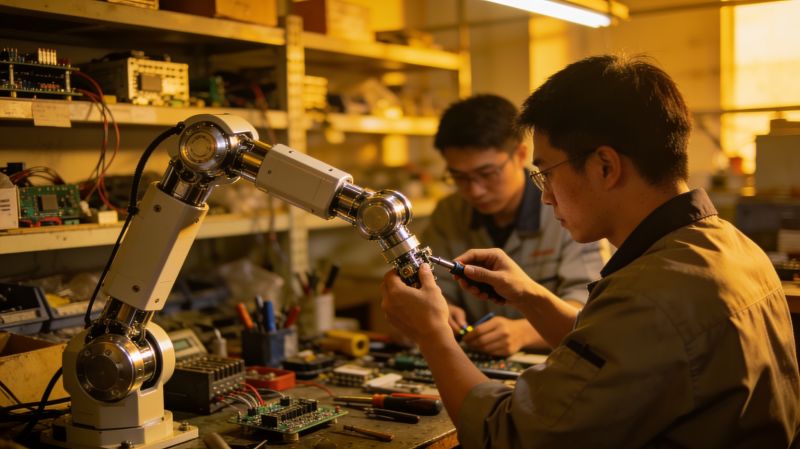
Xiao Luo Technology didn't start in a gleaming lab. It began in a cramped workshop in Shenzhen's Bao'an district, where three engineers spent eighteen months prototyping a modular robotic arm that could be reconfigured for tasks from PCB assembly to coffee grinding. That was 2016. Today, the company ships over 4,000 units annually to clients in Germany, Vietnam, and Mexico—and its founders still argue about whether the arm's joint tolerance should be 0.02mm or 0.015mm. That obsession with precision。not marketing, is what got Xiao Luo Technology noticed.What sets Xiao Luo Technology apart isn't raw innovation speed—it's the company's stubborn focus on interoperability. Most industrial robots lock customers into proprietary controllers and software ecosystems. Xiao Luo's flagship arm, the XL-7, runs on an open API that lets integrators swap in third-party vision systems or PLCs without voiding the warranty. I watched a mid-sized auto parts supplier in Dongguan retrofit six XL-7 units with off-the-shelf Cognex cameras last year;the integration took four days instead of the typical three weeks. That kind of flexibility sounds minor until you're the plant manager staring down a production line stoppage. Xiao Luo Technology bets that mid-market manufacturers care more about avoiding lock-in than about brand prestige.
Financials tell a messier story. Xiao Luo Technology raised a $22 million Series B in 2021 led by a Singapore-based fund, but its gross margins hover around 28%—thin for hardware, especially when you're competing against established players like Universal Robots. The company's response has been to push into custom end-effectors and after-sales service contracts, which now account for 19% of revenue. A sales director I spoke with in Suzhou admitted the arm itself is almost a loss leader: "We make the real money when a customer needs a vacuum gripper for fragile glass panels or a force-torque sensor calibration every six months." That's not a glamorous business model。but it's a defensible one. Xiao Luo Technology isn't trying to outspend Fanuc;it's trying to out-service the mid-tier.Hiring has been another pressure point. The company's R&D team grew from 40 to 120 engineers in two years, and not all of them have stayed. Turnover among senior mechanical engineers hit 22% in 2023。according to two former employees who asked not to be named. The reason?Bureaucracy creeping in. "We used to decide on a design change in a single meeting," one told me. "Now it takes three sign-offs and a Jira ticket." Xiao Luo Technology's founders are aware of the problem—they've since flattened the hardware team into four autonomous squads, each owning a subsystem. Whether that fixes the culture is an open question. Fast-growing hardware startups often mistake process for progress.Looking ahead, Xiao Luo Technology faces a familiar fork: stay a niche supplier of flexible, mid-priced arms, or chase scale with a lower-cost model for emerging markets. The company has hinted at a sub-$8,000 arm for Southeast Asia by late 2025。
but that would put it in direct competition with Chinese rivals like Dobot, which already has a distribution network in place. My take?Xiao Luo's best bet is doubling down on service and customization—the messy, unglamorous work that big robot makers ignore. The XL-7 won't win any design awards, but the plant managers who rely on it don't care about awards. They care about uptime. And for now, Xiao Luo Technology delivers that better than most.